Girlsday: a larger role for women in the biobased economy
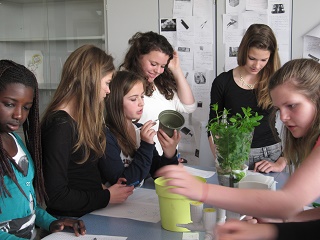
Women should play a larger role in the biobased economy, according to two practical women. And they used # Girlsday 2014 for an instruction of 24 observation year girls of … Read more
Over the past ten years, we witnessed a very unbalanced development in the global solar cells sector. China rapidly expanded its production capacity, and could therefore use the latest technology … Read more
The meeting of the Public Servants’ Sustainability Network in The Hague was innovative. Artistic contributions like paintings, a performance and positioning turned it into more than a purely intellectual exercise. … Read more
We are at a turning point in the energy transition, particularly as to the contribution of solar power, says Wim Sinke. So far, the instrument for opening up markets was … Read more
When I was a child we often went on a holiday to France. To get us through the long journey we’d bring along small packages of apple juice, those with … Read more
As companies strive to be more sustainable, their customers might grow more critical on their performance rather than less, asking questions that were never raised. At least, that is what … Read more
Whereas world capacity for biobased chemicals and materials is rapidly growing, Europe clearly lags behind. Lux Research, a Boston based company, expects a doubling of global biobased capacity in 2017 … Read more
Our industrial society exposes us to low doses of toxic substances. These are known to have health effects – but to what extent? For some time, air pollution and lung … Read more
The paper and pulp industry calls it MIMO: Multiple Inputs, Multiple Outputs. In other words: biorefinery of various resources in order to produce multiple end products. Of which the paper … Read more
Just five years ago, flying on bio jet fuel seemed an impossible dream. But SkyNRG developed a powerful concept that allows it to offer this product at an increasing number … Read more
As of today, the name of our website will be biobasedpress.eu. This is a better expression of who we are. Our twitter account was already called @biobasedpress. From now on, … Read more
In this series, we discussed three design rules: reduce capital costs and create jobs, be lean on materials flows, and preserve structure. Our last guideline, elegance is beautiful, sums up … Read more
Petrochemical industry breaks down the feedstock into its simplest components, and subsequently starts piecing all ‘building blocks’ together in order to arrive at the required products. Biobased industry will never … Read more
“Cheap batteries will revolutionise the renewable energy market,” wrote ex-Secretary of State for the UK Chris Huhne past Sunday in the Guardian. For the supply of renewable energy it’s usually … Read more
The future is to biobased, says DSM’s Anton Robek. In 10-20 years’ time, virtually all of DSM’s feedstock will be biobased. The question now is not if, but how fast … Read more
A biobased industry should not copy petrochemical industry’s structure: that structure has been optimised for over a century, for this particular feedstock. In order to compete, the biobased industry should … Read more
One of the discussion themes in the corridors of the World Bio Markets conference in Amsterdam last week, was industry-government relationships. Major European biobased industries feel frustrated that they invest … Read more
Will biomass ever be able to compete across a broad range of products with fossil feedstock, that is so much easier to recover and has such excellent economies of scale? … Read more
Researchers of the University of Amsterdam (UvA) have made a new step in the development of glycix, the only thermoset plastic that is both biobased and biodegradable. All inflexible plastic … Read more
‘Often, sustainability is not merely better, but cheaper too. Sustainable technologies lend themselves to local systems with far lesser control costs. That is the basis for a technological transition with … Read more
Pharmafilter is a Dutch company that has developed a new and sustainable system for processing hospital waste. It produces devices like bed-pans and urinals from a biobased and biodegradable plastic; … Read more
If plans work out as projected, Sardinia’s new Matrìca plant in Porto Torres might show the way into a new industrial future for the whole of Europe. The Matrìca project, … Read more
Most people, when talking about a sustainable future for Europe, think in terms of energy supply. That is one-sided. It is true: the energy conflict still deepens, as the incumbent … Read more
‘Socialise the risks and privatise the gains’ has been the reigning economic principle in the financial world in the past few years. Now such a mechanism also appears to be … Read more
Why on earth do we human beings have so much difficulty changing our thoughts – and our actions? For instance, change from a fossil economy to a green economy, from … Read more
We are right in the middle of the most radical transition that our society can go through: that of a centralistic, fossil-fuelled society to a much more decentralised society mainly … Read more
There is a very strange body of regulation for biobased innovation subsidies. These rules seem to be exclusively intended to direct biomass and agricultural wastes to the energy sector, ignoring … Read more
In fifty years’ time, technology has changed from the bogeyman to the saviour of mankind. Large-scale and energy intensive processes used to be the pinnacle of technology, producing much collateral … Read more
‘Frontrunners in horticulture should concentrate on fresh products that contain ingredients for a healthy diet and would be a remedy against diseases like cancer, obesity and diabetes2. The Netherlands have … Read more
The Dutch agricultural sector has one major problem: an excess of manure production as a consequence of the large livestock population. Dutch livestock farming depends on major imports of soy … Read more
The world needs a fantastic amount of knowledge, for its sustainable development, and in order to feed all new mouths. According to the OECD, we need to open three new … Read more
Human error is the label stuck on accidents that cannot be directly explained by the failure of a device, be it mechanical, electric or electronic. But the other side of … Read more
Biobased resources and biochemical processes will change the appearance of chemical industry. Changes may occur in scale and in location. There will be a tendency towards a smaller scale. But … Read more
The recent report ‘Strategy for a green society’ (in Dutch) of the Scientific and Technological Committee for the biobased economy (WTC) puts an emphasis on biobased materials. Biobased materials are … Read more
The Dutch Scientific and Technological Committee for the biobased economy (WTC) has published its second and last report. Elsewhere on this site, we will go into the committee’s recommendations, intended … Read more
‘Cradle-to-cradle (C2C) shows some undesirable developments, in particular in the process of awarding certificates. C2C has become a business model, and the famous certificate promotes recycling and therefore discarding of … Read more
Sorry, we publish this column on Dutch innovation policy in Dutch only.
Coffee-roasting house Peeze in Arnhem introduced the first fair-trade and climate-neutral coffee on the market, last month. In the production chain of this fair-trade coffee, CO2 emissions are first reduced … Read more
Sorry, we publish this article in Dutch only.
Sustainable supply chains are of great importance for the biobased economy, in terms of environmental conditions and respect for biodiversity, and also on issues of improving working conditions and farmers’ … Read more
‘The unique feature of our centre is the cooperation with the excellent plant science and green chemistry centres in our University,’ says Joe Ross, Director of the Biorenewables Development Centre … Read more
Europe’s biofuel policy has been reformulated earlier this year, in order to promote the development of second-generation biofuels. But this seems to have little effect: whereas second-generation biofuels from food … Read more
At EFIB, it was a surprise to me as a Dutchman, living in a country where agriculture is mainly about food crops, to learn that wood biorefinery is important in … Read more
Agriculture, with its renewable feedstock, materials, textile fibres, food products and medicinal plants, has been the supplier of mankind with its livelihood for ages. By innovations, agriculture will again take … Read more
Policy makers who aim to stimulate innovation, in the biobased economy for instance, sometimes exaggerate the importance of higher education. But getting innovations to be successful in pratice is highly … Read more
Renewable sources cannot cover more than 30% of our energy demand within the next 25 years. A clear-cut strategy for continued deployment of fossil energy sources is unavoidable in which … Read more
In part 1 we have shown the potential of biomass. We will now deal with sun and water as sources of renewable energy. We will give an estimate of the … Read more
Flax and hemp are making a comeback. Many new products contain these fibres. ‘But the growth does not yet entail large volumes,’ says David Kasse, an agricultural engineer in the … Read more
After a few decades of research and development a halfway score is meaningful and, on headlines, very well feasible. For various reasons wind and biomass are showing their limits. Solar … Read more