3D printed bioplastic: the future of construction?
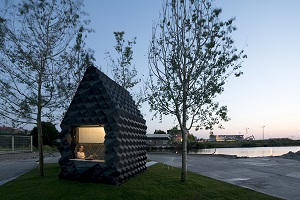
To date, most 3D printed buildings have been built from concrete. Could 3D printed bioplastic be a more sustainable option? Additive manufacturing, or 3D printing, is a major part of … Read more

Anyone attached to Greece (and I am one of them) knows moussaka, one of the most traditional dishes of the Greek kitchen. I have mixed feelings on it, even though … Read more
Since the turn of the century, there is a discussion raging on the limits to biomass use for energy purposes, in order to control man-made CO2 emissions. After having been … Read more
In September 2017, the FAO released a report on hunger in the world. According to this report, in 2016 11% of the global population experienced hunger, i.e. 815 million people, … Read more
Fifty years ago, the Club of Rome was founded; in its own words ‘an organisation of individuals who share a common concern for the future of humanity and strive to … Read more
In 1971 I did a work placement at Tel Aviv University in Israel. It was a wonderful and decisive period in my life. The researchers in the lab judged it … Read more
If business site Forbes devotes attention to a subject as esoteric as healthy soils, we know that there will be business in it. As science has discovered the importance of … Read more
‘Education is the most powerful weapon which you can use to change the world’ (Nelson Mandela). Hans Tramper is professor emeritus in Bioprocess Technology at Wageningen University and reflects on … Read more
BiofuelsDigest, the world’s most widely read biofuels daily, as they proudly claim, concluded in May this year that ‘The pace of invention and change is just too strong … to … Read more
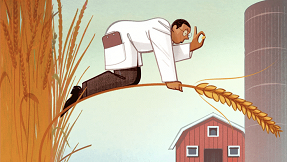
Food security is becoming an important issue even in Europe, where this year’s summer drought has led to significant crop failures. How can future food security be guaranteed in times … Read more
‘Education is the most powerful weapon which you can use to change the world’ (Nelson Mandela). Hans Tramper is professor emeritus in Bioprocess Technology at Wageningen University and reflects on … Read more
The world needs to start purposely to restructure chemical industry in such a way that it is based on renewable carbon instead of fossil fuels, says nova-Institute in its latest … Read more
Anyone who opposes genetically modified (GM) food can tell you that ‘in France’ they found that GM maize causes cancer in rats. This study was conducted under leadership of Gilles-Éric … Read more
This year, August 1 is Earth Overshoot Day. Each year, this is the day at which mankind has used up its stock of biological resources for that year. Never has … Read more
In the entire discussion on biotechnological rejuvenation, very few researchers ask the question why this should be a goal worth pursuing. In a series of articles (July 25, July 28 … Read more
Biotechnology has now reached the point that some researchers target rejuvenation as their goal, ultimately in humans. With a slight hint of immortality behind the horizon. But if we look … Read more
What will come after healthy aging? In biotechnology, advances have been so swift over the past few decades, that some scientists have started thinking of ways to tackle aging itself, … Read more
Gene technology is a much-discussed technology with almost endless opportunities. Opponents have objected to it right from the start. Their worry was and is, that researchers do not exactly know … Read more
Mycorrhiza fungi increase yields in a targeted and environmentally friendly way, robots help farmers to control weeds ecologically. Smallholders optimise outputs with sensors in the soil and with modern biorefineries. … Read more
Driven by government regulations and concerns regarding environmental preservation and depletion of natural resources, the bio-based solvents industry has faced an exponential rise in demand and a push towards the … Read more
In 1973, Stanley Cohen and Herbert Boyer of Stanford University and University of California, did the first successful recombinant-DNA experiments on the bacterium Escherichia coli. Through genetic ‘cutting and pasting’ … Read more
Imitating nature’s engineering secrets at the nanoscale could lead to a host of useful applications, like energy saving materials. Biomimicry, also called bionics, uses structures found in nature to solve … Read more
Among the wonderful new materials with unexpected properties that will change our world is microcrystalline cellulose. I got a new perspective on it through the lecture of Stéphane Laurent at … Read more
Only quite recently historically speaking, mankind acquired the know-how to change the properties of living species: as people settled and developed agriculture. But it required a revolution, much later, to … Read more
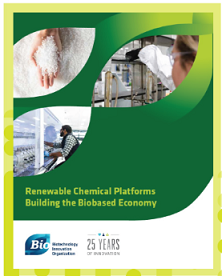
Companies around the globe are building the biobased economy as they commercialize renewable chemicals and biobased products. Collectively, their progress has reached a tipping point for accelerated growth in the … Read more
1973 was a remarkable year. We witnessed the first global energy crisis, leading to motor car-free Sundays in the Netherlands. In the US, president Nixon had to resign because of … Read more
An interesting article in the Guardian, last week, shed light on new strategies to combat insect attacks on food and commercial crops, through genetic modification. But in such a way … Read more
The impact of the new technologies, such as robotics, drones and Artificial Intelligence (AI) is revolutionizing our food production system. Precision farming has shaken up a number of large companies … Read more
The real sustainability revolution in farming is New Breeding Techniques like CRISPR. Why are organic farmers blocked from using them? This article by David Warmflash was originally published on the … Read more
Many universities and innovative companies are looking for new ways to close the future protein gap for food and feed, and cover future protein demand on a sustainable basis. German … Read more
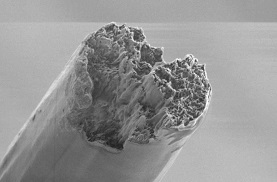
The strongest biomaterial ever has been assembled recently by Swedish, American and German researchers; it consists of cellulose, properly speaking of carefully parallel oriented cellulose nanofibrils (CNFs). The material is … Read more
Some two months ago, Dutch newspaper NRC Handelsblad opened with the news that biodiesel caused accelerated corrosion of unlined steel storage tanks in use at Dutch petrol stations. Being a … Read more
In February, BP published a new Energy Outlook. The main difference with previous outlooks lies in its renewable energy forecasts. The previous ones were scandalously low. The company partly redressed … Read more
These days, my inbox is overflowing with messages from concerned scientists warning that mankind cannot pursue economic growth forever; that it should deviate quickly from such a course, in order … Read more
The many ways in which mankind can produce natural compounds with biotechnology, impresses me. Smells, tastes, maybe texture in the near future, remember the synthetic burger, they are excellently produced … Read more
A new sustainable initiative in Bristol, in the UK, uses bio-based materials to face the need for additional and affordable housing supply: bio homes. Bristol is at the forefront of … Read more
Whereas some solar power projects are large-scale, covering entire fields, and other projects cover entire rooftops, solar power can also be used small-scale. Starting small is a good strategy for … Read more
At first glance, World Bio Markets in Amsterdam appeared to be another one of those biobased conferences with little news. There were speeches that told us how well companies were … Read more
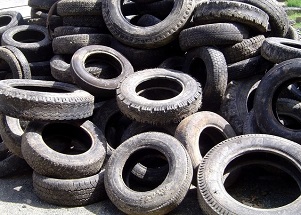
Every year, around a billion scrap tyres reach the end of their useful lives around the world. Many of these end-of-life tyres end up clogging landfills, providing breeding grounds for … Read more
One month ago me and my two fellow interns arrived in Chicago and started our work here at the Consulate-General of the Netherlands. The focus of my specific project is … Read more
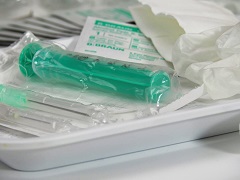
Dealing with hospital waste can be a logistical nightmare. But some believe that if medical centres switched to bio-based and biodegradable disposable products, they could simplify their waste management and … Read more
Ahoy Rotterdam was the scene of the Material Xperience trade show. The show exhibited a large number of new and innovative materials. ‘Meet the future of materials’, was the slogan … Read more
Two concepts, the bioeconomy and the circular economy, have much in common but seem to belong to different universes. Proponents of the circular economy treat the bioeconomy as a fringe … Read more
Are sustainability and moralism always connected? Proponents of sustainability often suggest (rather than openly say) that it is immoral to pursue non-sustainable development paths – to put the future of … Read more
As global housing programs are gearing up, the world will need a staggering amount of construction material over the next few decades. This will put a strain on resources, and … Read more
Last January, the news that a Chinese team of scientists had cloned macaque monkeys drew a lot of attention. Discussion was quick – too quick – to focus on the … Read more
Textiles made from pineapple leaves, self-massaging clothes, dresses made from fungi… During Material Xperience 2018 (13-15 March, Ahoy Rotterdam), fashion professionals can enjoy the marvel and the opportunities of many … Read more
Omega-3 fatty acids have attracted a lot of attention from protagonists of healthy diets, and from the food industry as well – view their ads. Fatty fish like salmon and … Read more
Concrete degradation is one of the most costly problems of our time. Concrete will always crack, although less so if well-designed and well-constructed. Cracks will allow water and air to … Read more
The 13th Material Xperience, ‘the world’s largest multisectoral materials exhibition’, will take place 13-15 March in Ahoy, Rotterdam. Tuned towards materials innovation, it will show materials in six categories: architecture, … Read more