
Change.inc contained an article by Teun Schroder on the sustainable transition. Does this make headway? Messages on blows to these goals abound. And yet…
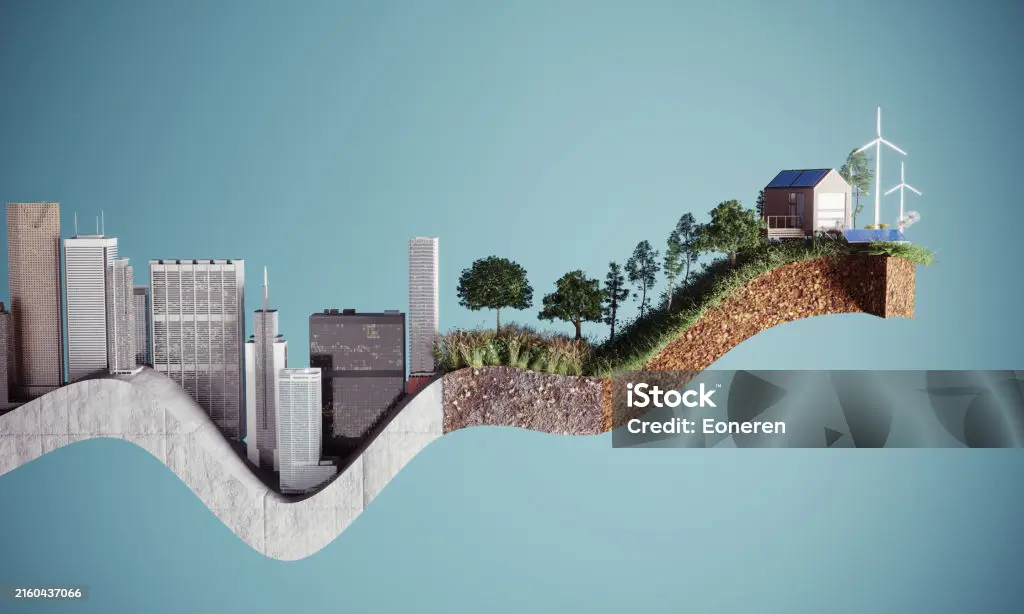 In the Netherlands, the Planning Agency for the Environment announced that the Netherlands will probably not conform to it’s set goal for 2030 (links in Dutch). Policy nibbles all the time on existing sustainability goals. The promised CO2 reduction will not be met. For instance, there will not come a larger CO2 storage capacity in the North Sea. Existing policy measures are being softened. The ambition for wind at sea in 2030 was turned back from 12 to 10 gigawatts; the plastic levy was postponed indefinitely; the SDE++ subsidy was cut; the CO2 levy for heavy industry was scrapped; subsidies for buyers of electric cars disappeared and the obligation to buy a hybrid heat pump instead of a CV unit from 2026 onwards was retracted.
European counterforce
European tendencies go into the same direction. Yes, the goal to reduce emissions by 90 percent in 2040 (relative to 1990) is still in force. But countries are allowed to compensate part of their emissions outside the EU; and the enlargement of the emission trade system (ETS II) is being postponed from 2027 to 2028. The obligation to report on sustainability (CSRD) is being postponed: in 2025 and 2026, companies do not have to report on the usually major scope 3-emissions. And the anti-frown away law CSDDD, that obliges companies to report on human rights and environmental issues in their supply chain, will only apply to very large companies: with a workforce of 5,000 and a turnover of 1.5 billion Euros.
Silence on the other side of the ocean
In the US, about the same happens. Early 2025, Trump announced once again to finish participation in the Paris Climate Agreement. Oil and gas companies can do as they like. Wind turbines are actively opposed by Trump (‘it’s driving the whales loco’). At least as worrying are the cuts in the budgets of institutes like the National Oceanic Atmospheric Administration (NOAA) and the Environmental Protection Agency (EPA), that have research programs on climate change. Funds are being withdrawn. Information of climate change is being removed from official sites and false claims on climate change are being voiced.

Positive signals
And yet, important innovations go on. There are hopeful signs for those who pay attention. In the Netherlands, each year witnesses a growth in the production of renewable energy, both solar and wind energies. Already 40% of all homes have solar panels on their roofs, with a total capacity (end 2024) of 28,6 gigawattpeak: almost four panels per inhabitant. World-wide, additions to renewable energy sources surpass all expectations. Research by the Energy & Climate Intelligence Unit (ECIU) reveals that solar energy develops fifteen times faster than projected in 2015; and that wind capacity has tripled.
Electric cars, too, grow beyond expectation. If growth continues, electric transport will have a share 66 percent higher in 2030 than projected earlier. In particular China grows fabulously in wind energy and solar electricity. About three quarters of the global additions in solar and wind energies is taken care of by that country.
Part of the explanation of this rise is the fabulous lowering of the costs of transition technologies. For instance, costs of solar energy and lithium-ion batteries fell by as much as 90 percent over the past fifteen years. The stock exchanges testify to the major growth of sustainable sources. In spite of Trump’s budget cuts, green investment funds have risen faster than stock exchanges in general. Analysts speak of ‘energy pragmatism’: governments and companies invest in both fossil and sustainable energies, in order to keep track of the growing demand for electricity, world-wide.
Companies set more ambitious goals
And although governments tend to exercise restraint in recent years, companies on the other hand judge climate goals to be ever more important; as signalled by the Science Based Targets Initiative in its recent trend report. The number of companies that set scientifically founded targets in order to reduce their emissions at short notice, doubled world-wide in the past year and a half. And ever more companies voice the importance of sustainability data for their results.
According to research by the renowned Carbon Disclosure Project, sustainability pays increasingly. Each Euro invested will save companies 46 Euros on average, primarily because they invest in mitigation of future climate risks. Global investments in renewable energy still rises, year after year. At present they represent over 2,000 billion dollars yearly. World-wide investments in fossil energy sources are pretty stable at just over 1,000 billion dollars.
In the US, individual states and governors meet the challenge, where federal government doesn’t. The US Climate Alliance, that represents both Democrats and Republicans, sticks to the climate ambition to become climate neutral in 2050. According to themselves, they represent 55 percent of the American population and 60 percent of the economy. And whereas Trump lets climate data disappear, Europe sets them straight.
Do we change course fast enough?
But is this fast enough? According to the recent Emission Gap Report of the United Nations, the goal of limiting global heating to 1.5 degrees doesn’t come nearer; even after countries submitted highlighted reduction plans (NCDs). Both Europe and China do not reach their goals. At present, we appear to head for 2.3 to 2.5 degrees heating. Better than the 3 degrees that we seemed to develop for in the past. Anyway, we should do everything to limit the period of 1.5 degrees or higher to as short a time possible. For, as the UN stresses: each fraction of a degree less heating will eventually lessen the possibility for irreversible climate damage and health risks.
Interesting? Then also read:
The energy transition is a digital transition too
Energy transition needs demand stimuli
Digitisation and energy transition