
Some suppose that trees and plants communicate with each other through fungal networks, sometimes across major distances -and even help each other. We wrote about that, earlier. But new data undermine this idyllic story.
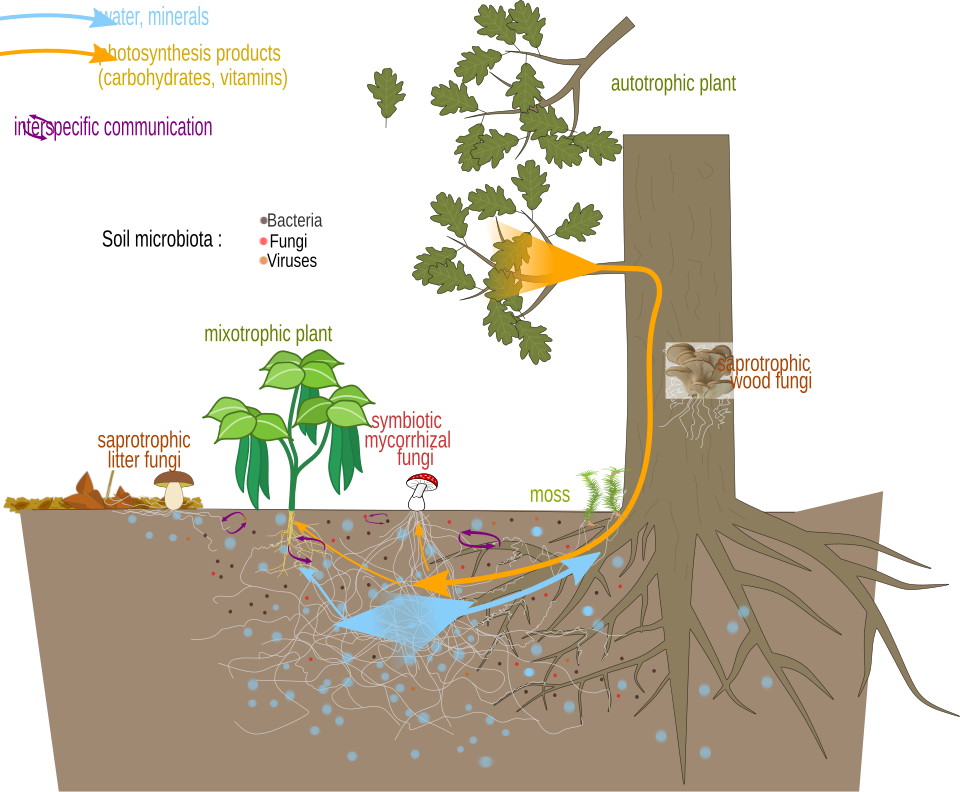
Trees as linking pins in cooperation
Frans van der Helm wrote about this issue in NRC Handelsblad of June 5, 2025 (in Dutch). His conclusion: even if trees talk, they lie. A major undermining of the concept of the ‘wood wide web’, the helpful natural internet. A concept that was lovingly embraced as cooperation in nature, on this site as well. But an illusion, on second thought.
In 1997, Canadian forest ecologist Suzanne Simard explained in Nature how trees exchange sugars, apparently with the aid of fungi. She argued that trees can also emit emergency signals; and purposely send aid to faraway neighbours in distress. Her message was popular. The wood wide web was born. Plants were supposed to be linked with their roots to vast underground fungal networks that could transfer messages and food. The discussion received a boost when German forest ecologist Peter Wohlleben published his bestseller The hidden lives of trees (2015). He perceived trees no longer as inert objects, but as intelligent creatures. They converse through fungi that connect their roots. A welcome message in a world in search for comfort. But nowadays, a message that meets with increasing criticism.
Below the surface, trees and shrubs are connected
At the root of Simard’s and Wohlleben’s concept lies that trees, shrubs and smaller plants are connected with each other – through mycorrhizal fungi. To mutual benefit. The fungi have a symbiotic relationship with plants. The branch even into the root-hairs of the plant. And all partners in this relationship profit from it. The plants receive difficult to access carbon compounds from the soil, the fungi receive carbon compounds thanks to the plant’s photosynthesis. And the mycorrhiza connect the roots of neighbouring trees. Does this have a special purpose?
Perhaps, this purpose could become apparent if the plant got eaten away? Suzanne Simard was of the opinion that plants emit substances as a warning to other plants. Distributed by their fungal network. But upon a closer look, this hypothesis doesn’t appear to be very plausible. A researcher says: what is the benefit to a plant, if others screw up their defences? Other plants, that are likely to be your competitors in the search for sunlight. This might be to your disadvantage. It may even be more plausible to suppose that plant one will seduce plant two into a useless investment in defence. Do harm to your neighbours, instead of being altruistic. Generally, close relatives will be in the neighbourhood of the plant under attack. Rather competitors than allies.

Forests – full of harmony and cooperation?
In the beginning, the evidence for a forest cover full of harmony, cooperation and help, has been judged in a somewhat flexible way. And above all, communicated selectively enlarged. Ecologist Justine Karst was flabbergasted. Together with her colleagues, she formed a second opinion on much-cited research on structure and function of underground fungal networks. They discovered that important assertions on the partnership of fungi and trees were based on just a few articles, cited over and over again.
But maybe, plants are unintentionally honest. In the sense that they cannot hide their defence reaction when they are being attacked. In that case, the warning they emit is an unintended reaction, rather than a real warning. We do not know if there is an honest trade-off in the flow of resources between fungus and plant.
In search for alternatives
Even in spite of the popularity of this view, researcher Justine Karst stayed looking for alternatives. Together with two colleagues, she investigated the written history of fungi of the woods. The amount of ‘extraordinary claims’ that they found in literature, surprised them. They decided to research themselves how these had originated. They found contradictions and generalisations. Like: seedlings grow or survive better, generally, if they are being connected with each other through underground networks. And that trees use these networks to signal danger, recognize offspring or share food ingredients with other trees. These all appeared to be untrue, or at most supported by a very flimsy evidence.
It also appeared that wishful thinking sneaked into the reproduction of facts; the ‘confirmation bias’ – the selective quotation of studies. If the subsequent author doesn’t read the original work, there is a possibility that the representation gets more and more distanced from reality. An example, a 2009 study that used genetic techniques to monitor the spread of mycorrhizal fungi. In course of time, this study was quoted as proof that trees disseminate food ingredients to each other – whereas the study didn’t in fact investigate the dissemination of food ingredients.
Disrupted enchantment
Originally, Nature published Suzanne Simard’s article. Now it published Karst’s and others’ findings. The general mood in which these were received? Karst: as a bit of a relief, I suppose. The enchantment was broken, as it were. This is good news for the field, as it opens up the way for alternative ideas on networks. And yet, Simard’s original concept was very promising. Recently, she enlarged her concept with ‘The Mother Tree’ – a tree that so to speak forms the inspiration for other trees in that area. This tree is somewhat older, wise and richly protective, and therefore takes much in her surroundings under her holistic wings. According to Simard we need to be open to the idea that woods are complex entities.
But the assertion that trees may recognize, communicate with, or provide next of kin with remedies, seems a bit early. The human communication structure isn’t the same as that of trees. Maybe, too many anthropomorphic concepts have sneaked into our vision of the wood. And gullible messaging might have distorted easily and unrecognizably research results. That could serve as a warning for both scientists and journalists.
Are fungal networks even important?
And then, are fungal networks as widespread and branched in woods as these passages suggest? According to Karst and her team, that is the question. Yes, fungal networks have been identified, by analyzing the dna of fungi near plant roots. But that has been done with just two of about seventy thousand tree varieties in the world. And to recognize next-of-kin – through a fungal network? The only controlled research done that found that plants communicate through their fungal networks, took place in a greenhouse. Plants that were attacked, ‘warned’ their neighbours through an increased release of organic compounds. We interpret that as a warning. But much more could be at stake.
There is also little proof for the idea that neighbouring trees and their offspring help each other. Some researchers do point out that fungal networks may transfer carbon compounds among trees. But this may also happen through the soil – maybe also in an environment free of fungi. Therefore, it seems too early to assert that networking trees recognize their next of kin, or emit signals and aid. But then, such assertions have often been made. For the time being, we have to retract them. Which doesn’t mean that the ideas were nonsensical. Plants communicate with each other – we just don’t know exactly how.
Interesting? Then also read:
Reductionism and holism in the life sciences
Fungi for healthy forests
The microbial food revolution