
Change.inc recently published an article by Jeroen de Boer (most references in Dutch) about remarkable innovations in wind energy. One of the fastest growing renewable energy sources. That growth is also responsible for a stream of innovations.
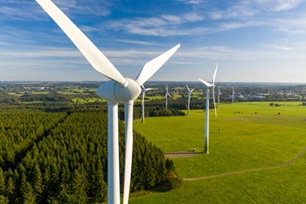
Particularly in China and Europe, wind energy becomes a growing part of the energy mix. Installed capacity worldwide grows very fast. A number of innovations is responsible for that turbulent development, and the other way around. At present, there is a world-wide capacity of 1.113 GW in 2024; and there is new capacity of more than 200 GW in the pipeline. This accelerates developments in the sector: from floating mega wind turbines at sea, to micro turbines for on your roof.
Optimal use of wind direction
Wind turbines generally react to the wind and it’s direction by themselves. They choose their own position. But according to the American National Renewable Energy Laboratory (NREL), this is inefficient. This institute investigated opportunities for communication between a group of wind turbines, together with the company Renewable Energy Systems (RES). This can be done through a so-called Dynamic Yaw System. The ‘yaw’ is the part of the wind turbine responsible for turning the vanes toward the wind, the position in which energy production is highest.
But sometimes, the yaw will react to short-lived gusts from another angle. It will not be necessary for energy production, to react to that. Traditionally, wind turbines do not communicate with each other. That’s why at times, they will all react in the same useless way. Bu thanks to a software system, information on such turbulence can be shared with other turbines; that’s why one turbine can warn the others, as it were, and that will prevent the occurrence of useless yaw movements.
New markets for two-bladed wind turbines
A two-bladed wind turbine contains less materials; therefore, it can be cheaper and easier to construct. But in two-bladed wind turbines, rotor blades move faster, and therefore they produce more noise. That’s why the three-bladed wind turbine now has got the upper hand.
And yet, two blades might make a comeback. Primarily at sea, where noise is less important. This summer, the Chinese company Envision Energy finalized a test on a two-bladed wind turbine, with satisfying results in the areas of power and efficiency.
Europe’s most powerful wind turbine
Bigger isn’t always better in the wind turbine industry; it costs a lot to build and site mega turbines. Those higher capital costs will have to balance against the extra energy production. Spanish-German company Gamesa is involved in the quest for larger turbines; the others are mainly Chinese companies. In April this year, Siemens installed Europe’s most powerful wind turbine, with a capacity of 21.5 MW, near test centre Østerild in Northern Denmark. It has a rotor diameter of 276 metres, and is one of the biggest and most powerful wind turbines world-wide. Even though it is still a prototype. It will need to pass a number of certification procedures – it is uncertain if this giant wind turbine will ever be exploited commercially.
Silent wind turbines in towns
The Australian startup VAWT-X Energy produces turbines with blades turning around a vertical axis. This renders wind turbines less vulnerable to turbulence. Therefore, they perform better at locations with changing wind directions – like in residential areas, on industrial sites and next to highways. Moreover, they produce just one quarter of the noise of traditional wind turbines, which makes them interesting for applications within towns.
But what is the efficiency of these silent wind turbines? Testing is still going on. In the Netherlands, work is in progress on such an alternative wind turbine. Cell Technologies company earlier presented The BladeX1.
Flying wind turbine
Beijing SAWES Energy Technology Company, a Chinese company, developed a form of zeppelin wind turbine, that will generate energy at a height of 1,500 meters. There, the S1500 will run into wind speeds three times as high as on the surface. The turbine is held at the ideal height by helium gas. In the middle of this monster are located twelve micro generators along which the wind flows. The electricity generated will be transported to ground level by means of a long cable. The Chinese company supposes that there will be need for its floating wind turbine in remote locations where energy is required quickly. For instance if a natural disaster has taken place; or at strategic locations where military operations are being conducted.
Micro wind turbines on your roof
German company SkyWind obtained an official certificate this month for its micro wind turbine, by the IC Small Wind Certification Council; after two year’s testing on among others electricity production and safety. This has established that the small turbine will be able to produce 615 kilowatthours of electricity, almost one quarter of what the average Dutch household uses. The diameter of the German small turbine with the name NG is 1.5 meters. Worldwide, sales amounted several tens of thousands already.
The world’s largest floating wind turbine
Chinese producer Mingyang last year installed the biggest floating wind turbine in the world: the OceanX. The V-formed colossus combines two wind turbines of which the rotor blades turn in opposite directions; total capacity is 16.6 megawatt. The system is 219 meters high; according to the producer, it will be able to produce 54 million kilowatthours of electricity yearly. The device rests on a flexible mooring system that moves with the waves; therefore it can be placed in deep sea areas. The floating colossus can withstand waves of up to 30 metres, and the rotor blades keep moving at wind speeds up to 260 km/hour.
Dutch company TouchWind has major ambitions with floating wind turbines as well, but with a different setup. The turbines of the Dutch startup float on the water surface with an angle, and they capture wind from behind instead of from upfront. They move into the correct position automatically and do not need foundations or monopiles.
Interesting? Then also read:
Hybrid wind parks, a solution to the congestion problem?
The era of SWB superpower
Towards clean energy superabundance